

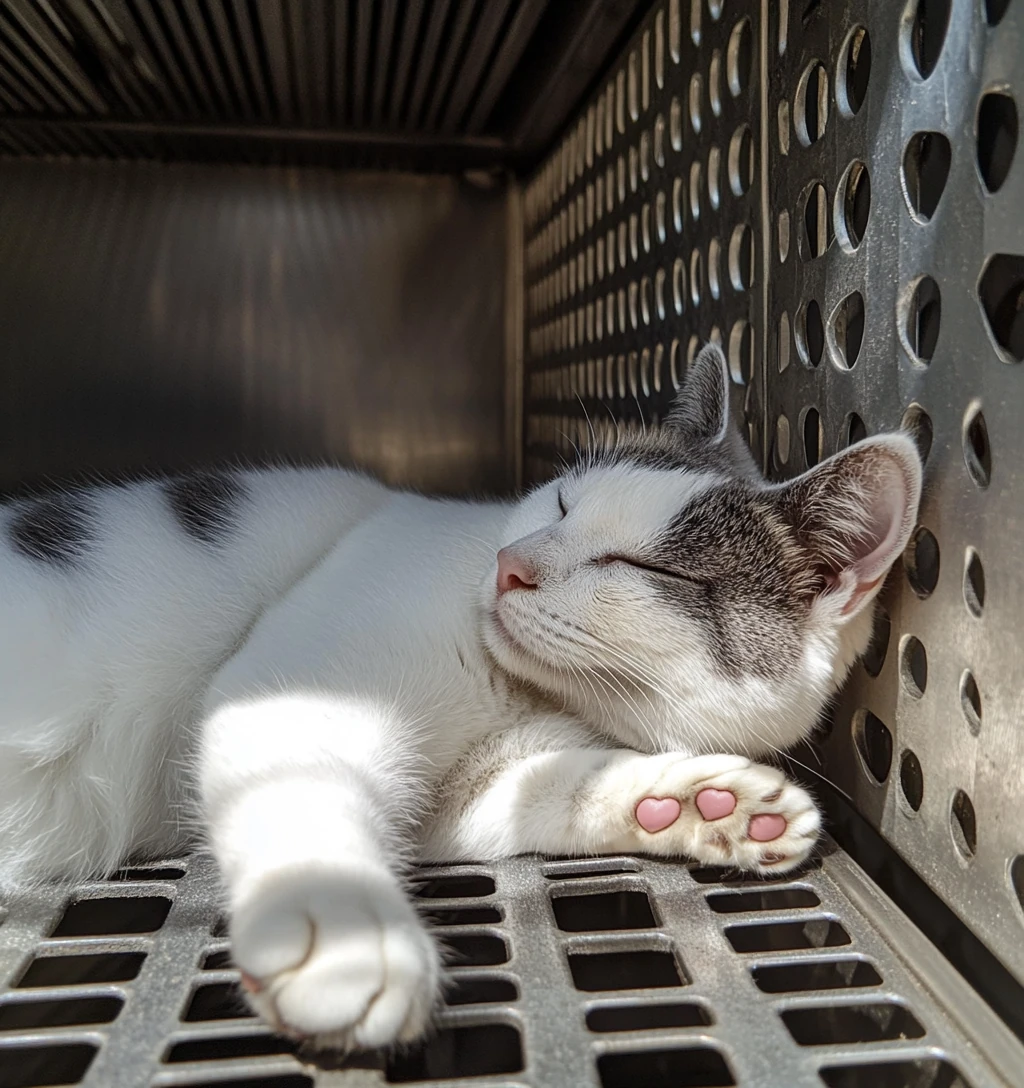
Yes. A healthy cat can travel a long distance by car, provided they ride in a secure carrier, the journey is broken up with regular stops and the car is kept at a comfortable temperature. That is how cats travel with us on our pet transport routes between the UK and Europe, from the two hour run between Calais and Folkestone to the seven hour journey from Amsterdam to London.
Being able to make the trip is not the same as enjoying it. Cats Protection says most cats find travelling stressful, and advises avoiding more than four hours of travel in a day if possible, with a break every two to four hours on longer journeys. For a house move or a relocation abroad, the useful question is how to keep a long journey calm and safe for your cat, and that is what this guide covers.
Why a long car journey is hard on a cat
International Cat Care explains that cats are usually strongly bonded to their own territory, where everything is familiar and they feel safe. A car takes all of that away at once. The sights, sounds and smells of a moving vehicle are all unfamiliar.
Watch for signs that the journey is making your cat unwell. Cats Protection lists vomiting, diarrhoea and excessive drooling, and recommends telling your vet if you see them so your cat can be examined and any health problem ruled out. If your cat has been sick or very anxious on a journey before, International Cat Care suggests asking your vet about medication that may help. Have that conversation before anything is booked, because it may change how the journey is planned. If your vet advises against a long journey for a cat with a health condition, take that advice before paying for any transport, ours included.
Choosing a carrier and getting your cat used to it
On a long journey your cat spends hours in its carrier, so it is worth choosing well. Cats Protection’s guide to choosing and using a cat carrier recommends a sturdy plastic or metal wire model that is strong, secure and easy to clean, with openings on at least two sides so your cat cannot overheat. It should be large enough for your cat to lie down comfortably and change position. The same guide warns that cardboard carriers get wet easily and most are not strong enough to transport a cat safely, and it does not recommend backpack carriers.
Then give your cat time to accept it. Cats Protection suggests bringing the carrier out at least a few days before the trip and leaving it open in a room where your cat likes to relax, with a familiar blanket and some treats inside. International Cat Care gives the same advice, to make the carrier a pleasant place to be well before the journey. The aim is a carrier that already smells and feels like home by the time it goes into the car.
On the day you travel
- Unless your vet has told you otherwise, Cats Protection suggests limiting food for at least a few hours before the journey. International Cat Care puts it at about four to five hours, in case your cat is sick on the way.
- Keep offering water. International Cat Care advises offering it right up until you leave, and again during the journey if you can.
- If your cat is nervous, Cats Protection mentions a pheromone spray used inside the carrier around 15 minutes before setting off.
- Cats Protection advises putting the carrier on a back seat, fastened in with a seat belt, and keeping your cat in it the whole time you are driving.
- Never put a cat in the boot. International Cat Care also warns about the back of a hatchback, where ventilation can be poor and a cat can overheat.
- Check that the heater or air conditioning is not blowing straight at the carrier.
A fastened carrier is also what the Highway Code asks of every driver. Rule 57 says animals in a vehicle should be suitably restrained so they cannot distract you while you drive, or injure you or themselves if you stop quickly, and it names a pet carrier as one way of doing that. A cat loose in a moving car is a risk to everyone in it.
Breaks, litter trays and overnight stops
On a long drive, plan your stops before you set off. Cats Protection recommends a break every two to four hours so you can check on your cat, with the litter tray ready so your cat can use it while you are stopped. It also advises against letting your cat in and out of the carrier often. On an overnight stay, let your cat out in the room where it will spend the night, so it has a closed, quiet space to stretch, eat and use the tray.
Our own timed routes work the same way. Amsterdam to London averages seven hours and London to Paris six, and both include a break every two hours, inside the two to four hours Cats Protection recommends. The further the destination, the more stops a journey needs, and how long pet transport to Europe takes varies a great deal from one route to another.
Never leave a cat alone in a parked car. International Cat Care warns that the temperature inside a car can rise very quickly, that parking in the shade with the windows open is not enough, and that heatstroke can be fatal. If you need to leave the car, the cat comes with you or someone stays with it.
Taking a cat across the Channel by car
If your journey continues into France or beyond, the crossing is the short part. With LeShuttle your pet stays in the car with you for the 35 minute crossing. Before boarding, you take your pet to the pet reception at Folkestone or Calais, at least an hour and no more than two hours before your booked departure. We are based on Cheriton Road in Folkestone, close to the LeShuttle terminal, and we can arrange a ferry crossing instead if you would prefer one.
The paperwork depends on which way you are travelling. To go from Great Britain into the EU, GOV.UK’s guide to taking your pet abroad says your cat needs a microchip, fitted before or at the same time as its rabies vaccination. The vaccination can only be given once your cat is at least 12 weeks old, and you must wait at least 21 full days after it before you travel. Your cat also needs an animal health certificate from an official vet, used to enter the EU within ten days of being issued. Cats do not need the tapeworm treatment that dogs need before arriving in Great Britain, but every pet coming back across the Channel has to travel on an approved route.
How a pet taxi looks after a cat on a long journey
If you cannot make the drive yourself, a pet taxi takes your cat from door to door. Our vehicles are well ventilated and temperature controlled, with secure enclosures, and our drivers check on every animal through the journey and give food and water as needed. You can travel with your cat, or stay at home and receive updates on how they are getting on. Closer to home, our pet taxi in Kent takes pets to vet visits and grooming appointments. We carry cats, dogs and ferrets of every breed and size. If you are weighing up whether a pet taxi is safe for dogs and cats, for a cat the answer starts with the carrier and the stops described above. The same habits help calm your pet during a long journey, whoever is driving.
Owners who have travelled with their cats have told us how it went. One wrote in a Google review, “Nice service, kind driver. Very satisfied and my cat was happy and healthy.” Another, Leah Ellement, travelled with two cats from Charles de Gaulle airport to London King’s Cross after a long flight from Canada, with a further train journey to Scotland still ahead of them.
Planning a long journey with your cat
A long car journey is manageable for most cats when the carrier is familiar before the day, the stops are planned and the paperwork is in order. Start with the carrier, talk to your vet if your cat has struggled before, and build in a break every few hours.
If you would like us to drive your cat, or both of you, contact Europe To UK Pet Taxi with your collection address, destination, travel dates and anything we should know about your cat. You can also request a pet taxi quote online.