

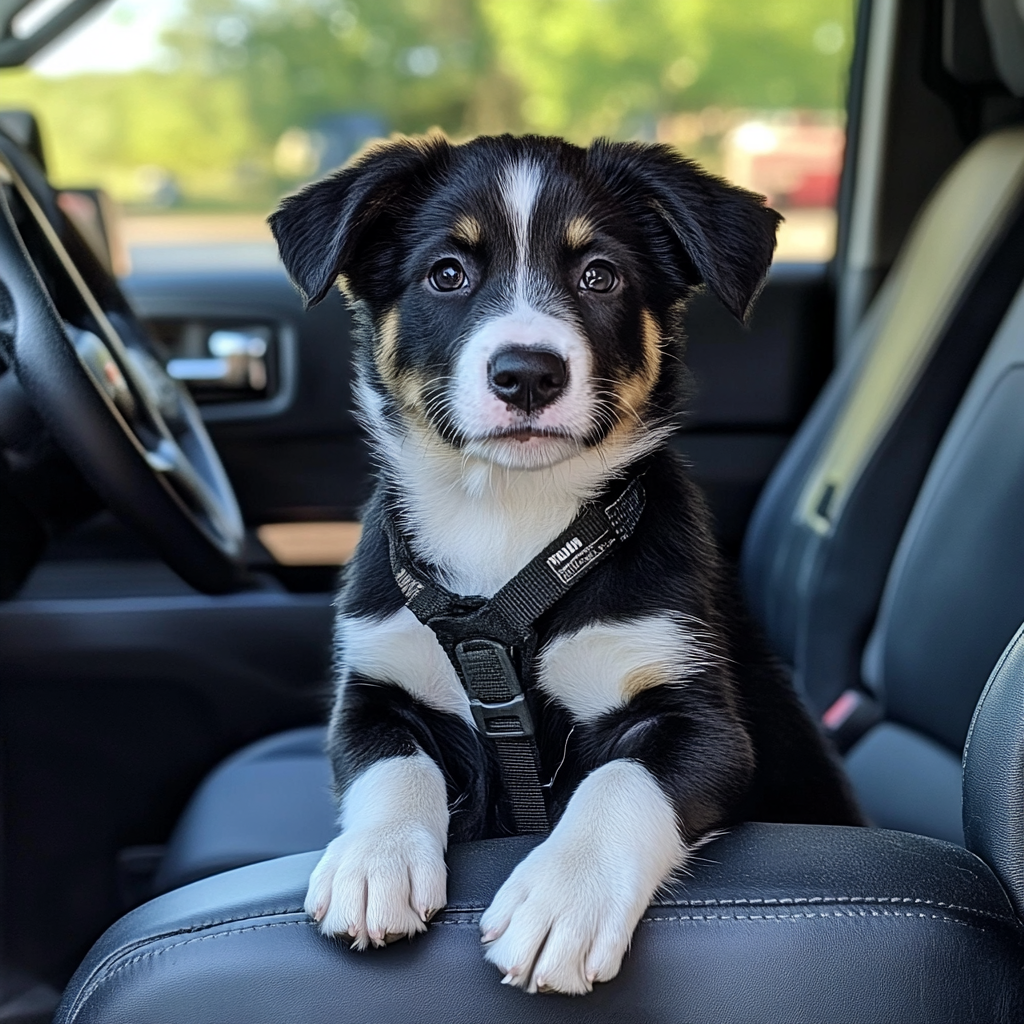
Yes, puppies can travel in a pet taxi, but only once they are legally old enough to cross the border. For a journey into Great Britain that means the puppy must be microchipped, vaccinated against rabies, and past the waiting period that follows that vaccination. A vet needs proof that a pet is at least 12 weeks old before vaccinating them, and you must then wait at least 21 full days after the first rabies vaccination before travelling. That puts the realistic earliest travel age at around 15 weeks, not 8 or 10 weeks as many new owners assume.
The practical answer for most people collecting a puppy from a breeder in France, Spain, Germany, the Netherlands or Belgium is that the journey happens later than they planned. We have this conversation regularly, usually with someone who has already paid a deposit and been given a collection date that is weeks too early. The transport itself is straightforward. The timing is what needs working out first, and it is worth getting right before any money changes hands.
The age rules, set out clearly
The minimum age is not a single fixed number. It is the result of three things stacked together.
Your puppy must be microchipped before, or at the same time as, their rabies vaccination. If the microchip goes in afterwards, the vaccination does not count and has to be done again. The vaccination itself cannot happen before 12 weeks of age. Then comes the waiting period, which is a minimum of 21 full days from the day after the vaccination, though some vaccines take longer to work and your vet should confirm which applies.
Certain vaccines carry their own age floors that push the date back further. A puppy given Canvac R must be at least 17 weeks old before travelling. A dog given Canvac DHPPiL plus R must have had three doses of the primary course, three weeks apart, and must be at least 21 weeks old before travelling. Those are not obscure edge cases. We have seen both come up, and neither is obvious from a vaccination card unless you know to look for the product name.
Dogs coming into Great Britain also need a tapeworm treatment given by a vet no less than 24 hours and no more than five days before arrival. Puppies are not exempt from this.
The rule change worth knowing about
The Animal Welfare (Import of Dogs, Cats and Ferrets) Act 2025 gives ministers the power to raise the minimum import age for puppies and kittens from 15 weeks to six months, alongside bans on importing mutilated animals and heavily pregnant dogs and cats. The Act is law. The detailed restrictions come through secondary regulations rather than the Act itself, so the age threshold that applies on your travel date depends on whether those regulations are in force by then.
We flag this to every owner planning a puppy collection several months ahead, because a breeding arrangement agreed in the spring for an autumn pickup is exactly the sort of plan that could be affected. Check the current position on GOV.UK before committing to a collection date, and ask your breeder what happens to your deposit if the rules move.
Why a puppy’s first long journey needs handling differently
A 15 week old puppy is not a small adult dog. It has had limited exposure to vehicles, it cannot hold its bladder for long, and the journey often coincides with leaving its litter for the first time. All of that shapes how the drive should be run.
In our experience, breaking a puppy journey into shorter driving blocks with more frequent stops works better than pushing through with adult-length stints because a young dog that gets out, relieves itself and resettles every couple of hours arrives calm, whereas one held in the vehicle for four or five hours at a stretch arrives agitated and often has an accident that then has to be cleaned up mid-journey. On an adult dog run from Paris or Brussels we would plan two or three proper stops. With a puppy on the same route we plan considerably more, and we say so when quoting rather than discovering it on the day.
Other things we do differently for young animals. We ask the breeder what the puppy has been eating and keep it on that rather than switching food mid-journey. We ask whether it has been in a car at all before, because for a lot of European litters the answer is no. And we ask owners to bring something with the litter’s scent on it, a piece of bedding or a cloth, which settles a puppy far more reliably than a new blanket does.
There is also a rule that catches people out on the way out of the UK. You cannot carry meat or dairy based products into the EU, and most puppy food falls into that category. Plan around it rather than assuming you can pack a bag of kibble.
What the paperwork needs to show
A puppy’s travel document has to record the date of birth, the microchip number along with the date it was fitted or read and where it sits on the body, the vaccination date, the vaccine manufacturer and product name, the batch number, the validity dates, and the vet’s signature and contact details. Entries in the wrong section of the document can stop a pet travelling.
We have found that puppy paperwork goes wrong more often than adult dog paperwork, and usually for the same reason. Breeders complete a lot of these documents and occasionally work from a template rather than the individual animal, so the microchip date or the date of birth ends up transposed or omitted. Because the date of birth is what a border officer uses to check the age rule, an error there is not a minor administrative slip.
When we take a puppy booking, we ask for a photograph of the completed document before travel rather than seeing it for the first time at the vehicle. That gives time to send it back to the breeder’s vet for correction. It is a small step and it has saved several journeys. It is also why the amount of preparation a pet journey needs tends to surprise first-time owners.
How the journey is structured
We collect from the breeder’s address or your address and deliver to the destination door, keeping the animal in the same vehicle throughout wherever the route allows. There are no handovers between drivers or transfers into a second vehicle, which matters more for a puppy than for a settled adult dog.
Our base is at 317A Cheriton Road in Folkestone, a few minutes from the LeShuttle terminal, so our standard crossing into Great Britain is Calais to Folkestone. The crossing takes around 35 minutes and the animal stays in the vehicle with the driver present throughout, rather than being left on a vehicle deck as happens on most ferry sailings. Any pet taxi bringing your puppy into Great Britain must be using a carrier and crossing on the approved list, so it is a fair question to ask any operator before booking.
You are also welcome to travel alongside your puppy rather than sending it unaccompanied, and for a first journey we would generally encourage it if your schedule allows. Owners who cannot travel get updates through the route instead.
We carry cats, dogs and ferrets with no restriction on breed or size, and our fleet includes a Mercedes Vito, a Skoda Kodiaq, a Skoda Octavia and a Citroën, which lets us match the vehicle to the job. A single puppy in a carrier and a litter mate pair travelling with crates and a new owner’s luggage are different propositions.
Bookings are secured with an initial payment of 50 percent, after which your LeShuttle ticket is confirmed and sent over. The balance falls due two days before travel, or you can pay in full in one go. Payment is by bank transfer or by card through a secure payment link, with the card option carrying a 2.5 percent processing fee. Plans change more often with puppies than with any other booking we take, usually because a vaccination date slips, so it is worth knowing that we can refund in full excluding card fees with at least 24 hours notice, subject to ticket type. LeShuttle Flexi tickets are refundable, while Day Trip, Overnight and Short Stay Saver tickets are not.
Planning your puppy’s journey
Ten years of running these routes has taught us that puppy collections are the bookings most likely to need rescheduling, and almost always for timing reasons rather than transport ones. Start from the date of birth, add the microchip and vaccination sequence, add the waiting period, then look at the calendar. That is the earliest your puppy can travel. The collection date the breeder offered is a proposal, not a permission.
Send us the puppy’s date of birth, the vaccination dates if they exist yet, the collection address and where the puppy is going, and we will put a quote together. We will tell you the earliest legal travel date, flag anything in the paperwork that looks likely to cause a problem at the border, and give you a realistic journey plan built around a young animal rather than an adult one.